Sideline Chess: The Throw-In Routines Making the Falcons Tick
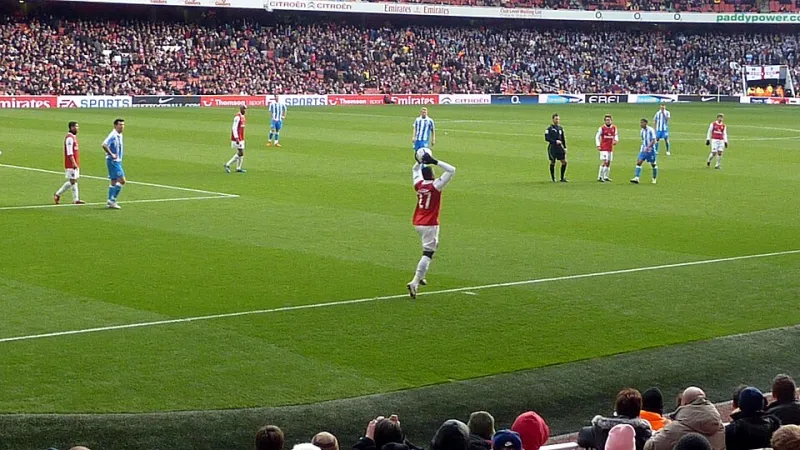
Photo: Wonker, CC BY 2.0, via Wikimedia Commons
Throw-ins are the bit of football people use to check their phone. At the Falcons, they are the bit worth watching. Across the 2026-27 campaign, Edinburgh have turned the humble restart into a proper territorial tool: not by launching every ball into the mixer, but by treating the touchline like a chessboard with a stopwatch.
The principle: win the next ball, not just the first
Most teams see a throw-in as a way to get the ball back in play. The Falcons see it as a way to set the next phase. The first contact matters, but the second ball matters more. If the first header or flick drops into an area where two Edinburgh players are already moving, the throw-in has done its job. If it drops to a lone defender surrounded by three opponents, it has not.
That is why you will often see a Falcons thrower take an age, stare down the line, then play a simple five-yard pass backwards. It looks negative. It is actually a reset. The team is buying time to push the full-back higher, pull the midfield across and create the pocket that makes the next ball winnable.
Three routines to watch on Saturday
The quick one. When the ball goes out near the halfway line and the nearest Falcons player grabs it immediately, watch the next three seconds. The aim is to move the opposition before they have set. A short throw into feet, a first-time lay-off and a switch to the far side. It rarely produces a highlight-reel goal, but it regularly produces a free run at the back four.
The stack. Two players stand close together near the touchline, almost blocking each other's path. One peels away late. The throw goes into the space he leaves, usually towards a target man who is already backing in. The flick-on is not meant to be the final ball. It is meant to land in the zone where the Falcons have a midfielder arriving unchecked.
The long release. This is the one supporters notice. It is also the one the Falcons use least. The long throw only comes out when the opposition has dropped deep and left a gap at the back post. Three players crowd the six-yard box, one hangs on the edge, and the aim is to force a knockdown. It is a pressure tool, not a default.
Match examples from 2026-27
The home win over Dunfermline in September was the clearest showcase. Around the hour mark, the Falcons kept the ball alive through three throw-ins in quick succession on the right. None of them went into the box. The third one went backwards to the centre-back, who switched it left. Two passes later the ball was in the net. The throw-ins did not make the goal. They made the space for it.
Away at Falkirk, the late equaliser came from a throw-in that looked like a mistake. The full-back took it short, received it back, then clipped it diagonally. The opposition had switched off because the ball had gone out. That is the point. A throw-in is the only restart where the team taking it can decide how quickly the game restarts. The Falcons are good at deciding.
Against Stirling, the long throw appeared twice in the final ten minutes. Both times it was aimed at the same player, and both times the second ball fell to a Falcons shirt on the edge of the box. One shot was blocked. One was headed wide. The routine did not need to be perfect to be effective. It kept the game in the opposition half.
Why it works: territory, second balls and late pressure
Territory is the obvious gain. A throw-in high up the pitch is worth more than a throw-in near your own corner flag. The Falcons are relentless about turning the former into the latter. They take quick throws when the opposition is disorganised and slow ones when they need to push bodies forward.
Second balls are the less obvious gain. Watch the players without the ball at a throw-in. The Falcons usually have one player dropping short, one pinned wide and one arriving late. That triangle is designed to mop up the first knockdown. It is not glamorous. It is how a team keeps a move alive when the first idea fails.
Late pressure is the payoff. When legs are tired and the clock is against you, a throw-in is a free chance to stop the opposition resetting. The Falcons use that. They keep the ball near the corner, force a defender to come across, then play the short one into the space he leaves. It is the sort of thing that does not show up in the highlights but does show up in the final five minutes.
Your Saturday checklist
You do not need a clipboard to watch for this. Start with the thrower. If he grabs the ball and looks forward immediately, expect the quick one. If he walks over slowly and waits for a teammate to jog across, expect the stack. If he stands still and waves players forward, expect the long release.
Next, count the Falcons players within ten yards of the throw. Two means quick. Three means routine. Four means the box is about to get crowded. Finally, watch the far-side winger. He is often the player the throw is really trying to free. If he drifts infield, the ball is probably going short. If he stays wide, the ball is probably going long.
The throw-in will never get its own song. But it might be the most Edinburgh thing about this Falcons team: unfussy, patient and quietly effective. On Saturday, when the ball goes out, do not check your phone. Check the touchline.